
Flat Rate vs Reducing Rate Calculator
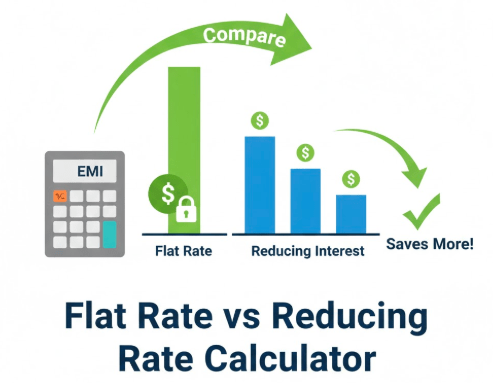
Flat Rate vs Reducing Rate Calculator – Complete Guide for Smart Borrowers (2026)
When you apply for a loan, the first number lenders highlight is the interest rate. However, what many borrowers fail to understand is that the method of interest calculation matters even more than the percentage itself. In fact, two loans with the same rate can have drastically different repayment amounts. Therefore, before you sign any agreement, it is essential to understand the difference between flat rate and reducing rate interest.
Moreover, aggressive marketing often makes flat rates look cheaper. On the other hand, reducing rates may appear higher at first glance. Nevertheless, the total repayment tells a very different story. As a result, using a Flat Rate vs Reducing Rate Calculator becomes extremely important in 2026.
In this detailed guide, you will learn how both methods work, why the difference matters, and how you can save thousands by choosing the right structure.
What Is a Flat Interest Rate?
Under the flat interest rate method, interest is calculated on the entire principal amount for the full tenure. In other words, even as you repay your loan month after month, the lender continues charging interest on the original amount.
For example, if you borrow ₹5,00,000 for five years, the interest is calculated on ₹5,00,000 for all five years. Consequently, the interest amount remains higher throughout the tenure.
Why It Looks Attractive
At first glance, a 10% flat rate appears affordable. However, this percentage does not reflect the effective borrowing cost. In reality, the actual equivalent reducing rate can be almost double. Therefore, borrowers who only look at the advertised rate may end up paying significantly more.
What Is a Reducing Balance Interest Rate?
In contrast, reducing balance interest works differently. Here, interest is calculated only on the outstanding principal. As a result, every EMI you pay reduces the principal, and therefore the next month’s interest also reduces.
Consequently, the total interest paid over the tenure becomes lower compared to a flat rate loan with a similar advertised rate.
Most banks use the reducing method for home loans and car loans. Moreover, this method is considered more transparent because the interest decreases over time.
Flat Rate vs Reducing Rate – Key Differences
Although both methods produce fixed EMIs, the internal structure is completely different. Therefore, understanding these differences helps you make smarter financial decisions.
| Feature | Flat Rate | Reducing Rate |
|---|---|---|
| Interest Calculation | On full principal | On outstanding balance |
| Total Interest | Higher | Lower |
| Transparency | Less transparent | More transparent |
| Effective Cost | Expensive long-term | Cost-efficient |
| Best For | Short tenure loans | Medium & long tenure loans |
Clearly, reducing rate loans provide better long-term value. However, flat rates may sometimes be useful for very short tenures.
Practical Example – Real Comparison
Let us compare both methods using the same loan details:
- Loan Amount: ₹5,00,000
- Tenure: 5 years
Scenario 1: 10% Flat Rate
Interest = ₹5,00,000 × 10% × 5
Total Interest = ₹2,50,000
Total Repayment = ₹7,50,000
Scenario 2: 10% Reducing Rate
Total Interest ≈ ₹1,37,000
Total Repayment ≈ ₹6,37,000
As you can see, the difference exceeds ₹1,00,000. Therefore, even though both loans mention “10%,” the repayment gap is massive.
Why Flat Rate Often Misleads Borrowers
Many lenders advertise loans saying “Only 11% Interest!” However, they do not always clarify that it is a flat rate. As a result, borrowers assume it is cheaper than a 16% reducing rate.
In reality, 11% flat can equal 19–21% reducing rate, depending on tenure. Therefore, always convert and compare before finalizing.
When Should You Choose Flat Rate?
Although reducing rate is generally better, there are certain situations where flat rate may work:
- Very short tenure (6–12 months)
- Small-ticket personal loans
- Quick business funding
Even then, you must calculate total repayment. Otherwise, you may unknowingly increase your borrowing cost.
When Is Reducing Rate Better?
Reducing rate is better in most structured loans. For instance:
- Car loans
- Home loans
- Large personal loans
- Business expansion loans
Since interest reduces monthly, your long-term savings improve significantly. Furthermore, prepayment becomes more beneficial because it directly reduces future interest.
Flat Rate to Reducing Rate Conversion (Quick Estimate)
As a general rule:
Flat Rate × 1.8 to 2 ≈ Reducing Rate Equivalent
For example:
- 10% flat ≈ 18–20% reducing
- 12% flat ≈ 21–24% reducing
However, the exact conversion depends on tenure. Therefore, always use a calculator instead of relying on rough estimates.
How a Flat Rate vs Reducing Rate Calculator Helps
Instead of manually applying formulas, you can simply:
- Enter loan amount
- Enter tenure
- Enter flat rate
- Enter reducing rate
- Compare EMI and total repayment
Immediately, you will see which loan is actually cheaper. Consequently, you can make a confident and informed decision.
Moreover, the calculator eliminates guesswork. As a result, you avoid costly mistakes.
Common Mistakes Borrowers Make
Firstly, many borrowers compare only interest percentages.
Secondly, they ignore total repayment amount.
Additionally, they overlook processing fees and prepayment penalties.
Finally, they focus only on EMI affordability rather than total cost.
Therefore, always evaluate the full financial picture.
Impact on Different Loan Types
Personal Loans
Many NBFCs offer flat rates. Therefore, comparing effective rates becomes essential.
Car Loans
Banks usually offer reducing rates. However, dealership financing may use flat rates.
Business Loans
Short-term loans often use flat structures. Nevertheless, longer-term business loans typically use reducing methods.
Home Loans
Almost always reducing rate, as the tenure is long.
Smart Borrower Strategy for 2026
Before signing any loan agreement:
- Ask clearly whether the rate is flat or reducing
- Request amortization schedule
- Compare effective annual rate
- Use a comparison calculator
Ultimately, the goal is not to get the lowest-looking rate, but to get the lowest total repayment.
Final Verdict
In most cases, reducing rate loans are more economical. Although flat rates appear attractive, they usually cost more over time. Therefore, unless the tenure is very short, reducing rate is the smarter choice.
In conclusion, understanding interest calculation methods can save you thousands. Consequently, always use a Flat Rate vs Reducing Rate Calculator before committing to any loan.
Smart financial decisions begin with proper comparison — and comparison begins with clarity.