
Loan Amortization Schedule Generator
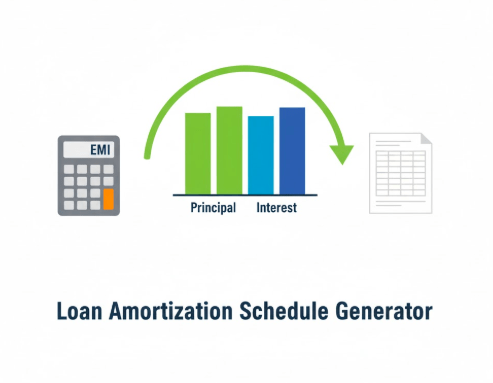
Loan Amortization Schedule Generator – Complete EMI Breakdown & Interest Planning Guide (2026)
When you take a loan, the EMI figure is usually the first number you focus on. However, EMI alone does not reveal the complete financial picture. In reality, what truly matters is how each payment is divided between principal and interest over time. That is precisely why a Loan Amortization Schedule Generator is such a powerful financial tool.
Most borrowers check affordability first. Nevertheless, affordability without structure analysis can be misleading. Therefore, if you want to reduce interest cost and repay strategically, understanding your amortization schedule becomes essential.
In this comprehensive guide, you will learn how amortization works, why it matters, and how to use a schedule generator to save substantial money over the life of your loan.
What Is a Loan Amortization Schedule?
A loan amortization schedule is a detailed repayment table. Specifically, it shows:
- EMI amount
- Interest paid each month
- Principal repaid each month
- Remaining outstanding balance
In simple terms, it tells you exactly how your loan behaves from the first EMI to the last.
Although your EMI remains constant in most reducing-rate loans, the internal structure changes every month. Initially, the interest portion is significantly higher. Gradually, however, the principal component increases. As a result, your outstanding balance reduces slowly at first and then faster toward the end.
Therefore, without an amortization schedule, you are only seeing half the picture.
Why EMI Alone Is Not Enough
Many borrowers assume that if EMI fits their monthly budget, the loan is manageable. However, they rarely examine total interest outflow. Consequently, they often underestimate the real borrowing cost.
For example:
- Loan Amount: ₹20,00,000
- Tenure: 20 years
- Interest Rate: 9%
The EMI may look comfortable. Nevertheless, the total interest payable could exceed ₹23–25 lakhs.
Thus, while EMI appears affordable, the long-term cost may be substantial. This is exactly why reviewing the amortization schedule is critical.
How a Loan Amortization Schedule Generator Works
A Loan Amortization Schedule Generator automates complex calculations. Instead of using Excel formulas manually, you simply enter:
- Loan amount
- Interest rate
- Loan tenure
After that, the tool instantly generates a month-by-month repayment table. Moreover, advanced generators also show yearly summaries and total interest calculations.
As a result, you gain clarity within seconds.
Practical Example – Understanding the Breakdown
Let us examine a realistic scenario:
Loan Details:
- ₹10,00,000
- 10 years
- 10% annual interest
Month 1:
- EMI: ₹13,215 (approx.)
- Interest: ₹8,333
- Principal: ₹4,882
- Outstanding: ₹9,95,118
Notice how more than 60% of the EMI goes toward interest initially. Therefore, early-stage repayment hardly reduces principal.
Year 5:
By the fifth year, however, the structure shifts. The principal portion becomes larger than the interest portion. Consequently, the outstanding balance begins declining more rapidly.
This gradual shift is what an amortization schedule clearly illustrates.
Why This Tool Is Financially Powerful
1. Enables Smart Prepayment Decisions
If you prepay during the early years, you cut high-interest exposure. Consequently, even a modest lump-sum payment in year two can save significant interest over time.
2. Helps Compare Tenure Options
For instance, you can compare:
- Higher EMI + Shorter tenure
versus - Lower EMI + Longer tenure
Although lower EMI feels comfortable, longer tenure increases total interest. Therefore, comparing both scenarios through a schedule generator leads to smarter decisions.
3. Improves Loan Negotiation
When you understand repayment structure, you negotiate confidently. Moreover, lenders are more transparent when borrowers ask informed questions.
Where Amortization Matters Most
Home Loans
Since tenure extends 15–30 years, interest accumulation becomes massive. Therefore, amortization visibility is essential.
Car Loans
Although tenure is shorter, early repayment can still save meaningful interest.
Personal Loans
Because interest rates are higher, principal reduction strategies become even more important.
Business Loans
Cash-flow planning improves significantly when repayment breakdown is clear.
Fixed EMI vs Floating Interest – Important Insight
In fixed-rate loans, EMI and interest remain stable. However, in floating-rate loans, interest rates may change periodically. Consequently, EMI or tenure may adjust.
Therefore, floating-rate borrowers should regenerate amortization schedules after every rate revision. Even a 0.5% increase can impact total repayment significantly.
Step-by-Step: How to Use a Loan Amortization Schedule Generator
- Enter the principal amount
- Input annual interest rate
- Select tenure in years or months
- Click “Generate”
- Review the monthly table
After reviewing, download or save the schedule. Furthermore, revisit it whenever you plan prepayment.
Advanced Strategy: Save Lakhs Through Minor Adjustments
Consider a ₹40 lakh home loan at 9% for 20 years.
Total interest may exceed ₹46 lakhs.
Now imagine increasing EMI by just ₹3,000 per month. Although the monthly burden rises slightly, the interest savings could reach ₹6–8 lakhs. Additionally, the tenure may reduce by several years.
Without an amortization schedule generator, these savings remain invisible. Therefore, this tool empowers long-term financial control.
Common Borrower Mistakes
Firstly, many borrowers ignore the interest-heavy early years.
Secondly, they delay prepayments unnecessarily.
Additionally, they extend tenure for comfort without comparing total cost.
Finally, they fail to monitor floating-rate adjustments.
Consequently, they end up paying far more than required.
Amortization Schedule vs EMI Calculator
An EMI calculator provides:
- Monthly EMI
- Total interest payable
However, an amortization schedule generator provides:
- Exact monthly principal-interest split
- Outstanding balance at any point
- Prepayment impact visibility
- Yearly repayment insights
Therefore, while EMI calculators are useful, amortization schedules are strategic tools.
Tax Planning Advantage
For home loans in India:
- Interest qualifies under Section 24(b)
- Principal qualifies under Section 80C
Since tax deductions depend on yearly interest amount, reviewing amortization helps estimate tax benefits accurately. Consequently, you can plan investments and repayments more efficiently.
Real-Life Example – Strategic Borrower
A borrower takes ₹25 lakh home loan at 8.5% for 25 years.
Initial total interest: ₹32+ lakhs.
After reviewing the amortization schedule, he decides to:
- Increase EMI by ₹2,500
- Make ₹1 lakh prepayment in year 3
As a result:
- Loan tenure reduces by nearly 4 years
- Interest savings approach ₹7–8 lakhs
Therefore, small adjustments lead to substantial long-term benefits.
Should You Reduce EMI or Tenure After Prepayment?
Banks typically offer two options:
- Reduce EMI
- Reduce tenure
Although reducing EMI provides short-term relief, reducing tenure saves more interest. Therefore, unless cash flow is tight, tenure reduction is financially superior.
Why Every Borrower Should Use This Tool in 2026
Interest rates fluctuate frequently. Moreover, loan tenures are becoming longer. Consequently, understanding repayment structure is no longer optional.
A Loan Amortization Schedule Generator provides:
- Transparency
- Strategic planning power
- Interest-saving opportunities
- Better refinancing decisions
Ultimately, it converts a loan from a blind commitment into a controlled financial plan.
Final Conclusion
Loans are long-term obligations. However, clarity transforms obligation into strategy. While EMI tells you what you pay, amortization tells you how you pay.
Therefore, before finalizing any home loan, car loan, or personal loan, generate your amortization schedule. Study the early interest dominance. Plan prepayments wisely. Monitor floating-rate changes regularly.
Financially aware borrowers do not just accept loan terms — they analyze them.
And that analysis begins with a Loan Amortization Schedule Generator.